
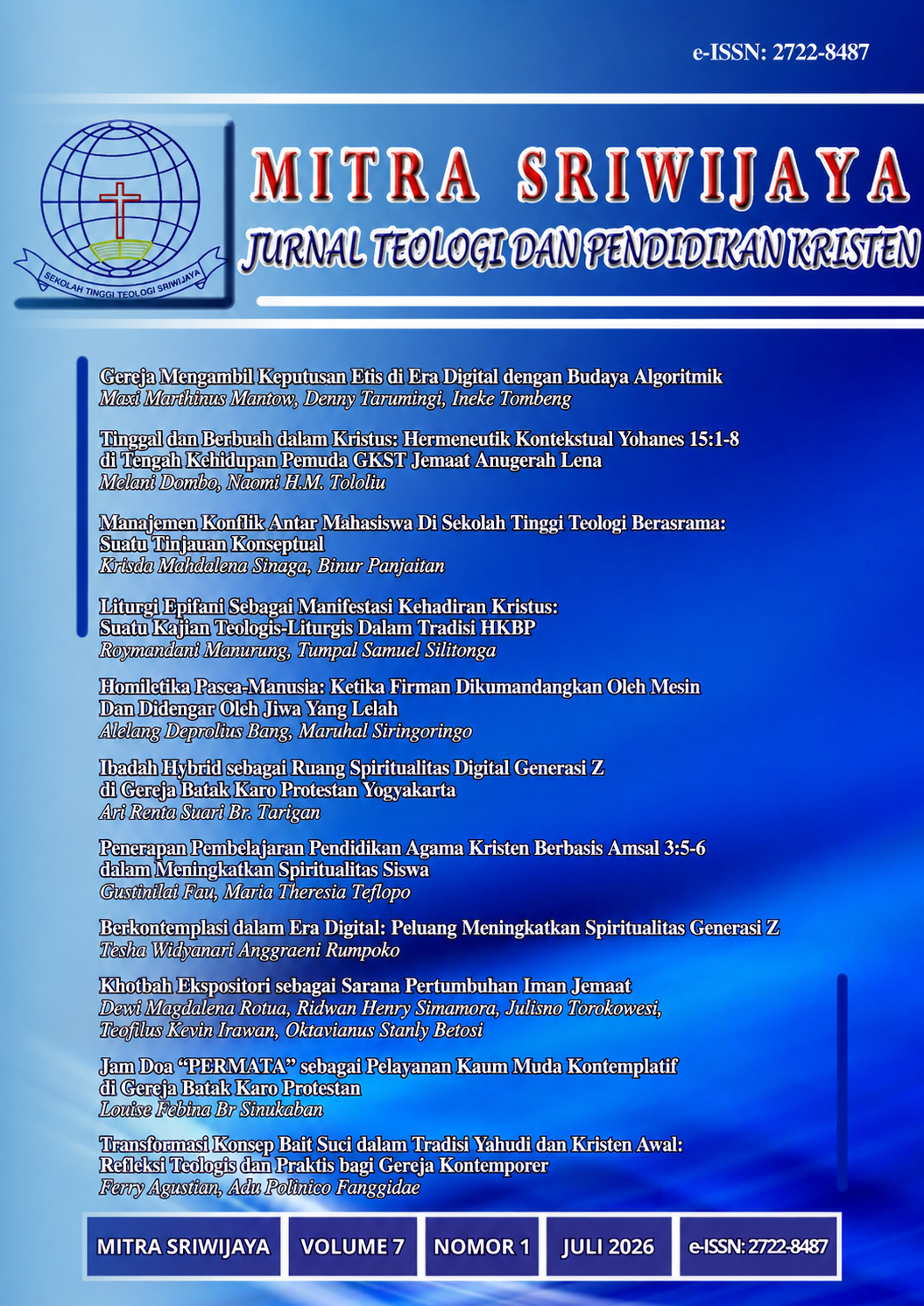
Homiletika Pasca-Manusia: Ketika Firman Dikumandangkan Oleh Mesin Dan Didengar Oleh Jiwa Yang Lelah
Article Sidebar
Main Article Content
Abstract
This study examines the dynamics of homiletics in the posthuman era, where the proclamation of God's Word is increasingly mediated by artificial intelligence and received by individuals experiencing existential exhaustion. The research asks how artificial intelligence reshapes the nature of homiletics and to what extent the spiritual dimension of preaching can be sustained within digital environments. Accordingly, the study aims to analyze the relationship between artificial intelligence, digital media, and the proclamation of the Word from the perspective of practical theology. Employing a qualitative-descriptive approach, the research utilizes theological hermeneutics and an interdisciplinary literature review encompassing theology, philosophy of technology, and digital communication. The findings reveal that although artificial intelligence can replicate the rhetorical form and structural composition of sermons, it remains incapable of embodying the transcendent spiritual dimension without the participation of human consciousness, lived faith, and spiritual experience. The interaction between algorithmic systems and the human soul opens new horizons for theological reflection concerning divine presence in digital spaces. The study concludes that posthuman homiletics requires a reconstruction of the relationship between the Word, its communicative medium, and its hearers, while affirming that God's presence transcends technological limitations and can nevertheless be proclaimed creatively through digitally mediated platforms that retain genuine spiritual significance.
Article Details

This work is licensed under a Creative Commons Attribution-ShareAlike 4.0 International License.
References
Bang, A. D. (2025). Digital Homiletics: Teologi dan Praktik Khotbah Online di Era Pasca-Pandemi. Missio Ecclesiae, 14(2), 142–254. https://doi.org/https://doi.org/10.52157/me.v14i2.415
Bostrom, N. (2003). Human Genetic Enhancements: A Transhumanist Perspective. The Journal of Value Inquiry, 37(4), 493–506. https://doi.org/10.1023/B:INQU.0000019037.67783.d5
Büssing, A., Winter, S., & Baumann, K. (2020). Perception of Religious Brothers and Sisters and Lay Persons That Prayers Go Unanswered Is a Matter of Perceived Distance from God. Religions, 11(4), 178. https://doi.org/10.3390/rel11040178
Dickinson, D. L. (2024). Deliberation, mood response, and the confirmation bias in the religious belief domain. Journal of Behavioral and Experimental Economics, 109, 102161. https://doi.org/10.1016/j.socec.2024.102161
Dorobantu, M. (2023). Imago Dei in the Age of Artificial Intelligence: Challenges and Opportunities for a Science-Engaged Theology. Christian Perspectives on Science and Technology, 1, 175–196. https://doi.org/10.58913/KWUU3009
Freitas, T. A. F. (2026). The Homily in the Algorithmic Age: Mediation, Delegation, and the Irreducibility of the Subject. Religions, 17(6), 630. https://doi.org/10.3390/rel17060630
Ganc, D. (2025). Towards Theology of Parenthood: Exploring Foundations in Pope Francis’ Apostolic Exhortation “Amoris Laetitia.” Bogoslovni Vestnik, 85(1), 83–95. https://doi.org/10.34291/BV2025/01/Ganc
Garg, R., Han, J., Cheng, Y., Fang, Z., & Swiecki, Z. (2024). Automated Discourse Analysis via Generative Artificial Intelligence. Proceedings of the 14th Learning Analytics and Knowledge Conference, 814–820. https://doi.org/10.1145/3636555.3636879
Gilbert, P., & Van Gordon, W. (2023). Compassion as a Skill: A Comparison of Contemplative and Evolution-Based Approaches. Mindfulness, 14(10), 2395–2416. https://doi.org/10.1007/s12671-023-02173-w
Groarke, J. M., Groarke, A., Hogan, M. J., Costello, L., & Lynch, D. (2020). Does Listening to Music Regulate Negative Affect in a Stressful Situation? Examining the Effects of Self‐Selected and Researcher‐Selected Music Using Both Silent and Active Controls. Applied Psychology: Health and Well-Being, 12(2), 288–311. https://doi.org/10.1111/aphw.12185
Herzfeld, N. (2002). Creating in Our Own Image: Artificial Intelligence and the Image of God. Zygon: Journal of Religion and Science, 37(2). https://doi.org/10.1111/0591-2385.00430
Hosseini, M., Rasmussen, L. M., & Resnik, D. B. (2024). Using AI to write scholarly publications. Accountability in Research, 31(7), 715–723. https://doi.org/10.1080/08989621.2023.2168535
Hussey, I. (2024). Preaching and Generative AI: A Perspective from Early 2024. International Journal of Practical Theology, 28(2), 307–323. https://doi.org/10.1515/ijpt-2024-0003
Indarto, N. D. K., & Nanulaitta, T. (2024). Misi Kontemporer: Utilitas Teknologi Dalam Misi Kristen Masa Kini. Mitra Sriwijaya: Jurnal Teologi Dan Pendidikan Kristen, 4(2), 130–150. https://doi.org/10.46974/ms.v4i2.107
Istadiyantha, I. (2021). Reinterpreting the Indonesia’s Relations with the Middle East towards the Era of Society 5.0. IJISH (International Journal of Islamic Studies and Humanities), 4(1), 72. https://doi.org/10.26555/ijish.v4i1.2028
Jayadi, K., Abduh, A., & Basri, M. (2022). A meta-analysis of multicultural education paradigm in Indonesia. Heliyon, 8(1), e08828. https://doi.org/10.1016/j.heliyon.2022.e08828
Kaewkitipong, L., Beaunoyer, E., Ractham, P., & Guitton, M. J. (2023). Augmented spirituality: Renewing human spirituality in a technology-driven world? Computers in Human Behavior, 148, 107904. https://doi.org/10.1016/j.chb.2023.107904
Kruger, F. P. (2025). Exploratory Homiletical Perspectives on the Influence of AI and GAI on People’s Cognition and Reasoning About Warfare in the Era of Homo Digitalis. Religions, 16(2), 251. https://doi.org/10.3390/rel16020251
Kumar, D., & Uchoi, E. (2025). Using artificial intelligence for spiritual well-being: conceptualizing predictive models. Journal of Spirituality in Mental Health, 27(4), 623–651. https://doi.org/10.1080/19349637.2025.2454427
Mannerfelt, F., & Roitto, R. (2025). Preaching with AI: an exploration of preachers’ interaction with large language models in sermon preparation. Practical Theology, 18(2), 127–138. https://doi.org/10.1080/1756073X.2025.2468059
Mansour, N. (2022). The Holy Light of Cyberspace: Spiritual Experience in a Virtual Church. Religions, 13(2), 121. https://doi.org/10.3390/rel13020121
Matthes, J., Karsay, K., Schmuck, D., & Stevic, A. (2020). “Too much to handle”: Impact of mobile social networking sites on information overload, depressive symptoms, and well-being. Computers in Human Behavior, 105, 106217. https://doi.org/10.1016/j.chb.2019.106217
McGrath, J. F. (2025). ChatGPT and Biblical Studies. Interpretation: A Journal of Bible and Theology, 79(2), 126–135. https://doi.org/10.1177/00209643241308583
McLaughlin-Sheasby, A. (2024). Proclamation and Power: Toward a Phenomenology of Preaching and Its Affects. Religions, 15(4), 392. https://doi.org/10.3390/rel15040392
Md. Ishaque, Mahmudulhassan, M., & Muhammad Abuzar. (2023). Sustaining Digital Faith: How Technology Impacts Religious Activities and Participation in the Digital Era. Bulletin of Islamic Research, 1(2), 177–188. https://doi.org/10.69526/bir.v1i2.338
Naidoo, P. G. M., & Nicolaides, P. A. (2025). Prospects and Challenges in Artificial Intelligence use and the Christian faith: Augustinian and other considerations. Pharos Journal of Theology, 106.4. https://doi.org/10.46222/pharosjot.106.4032
Nirwana AN, A. (2024). Multimedia Tafsir: Exploring the Meaning of the Quran in the Digital Era. SSRN Electronic Journal. https://doi.org/10.2139/ssrn.4785707
O’Lynn, R. (2023). The Digital Media Sermon: Definitions, Evaluations, Considerations. Religions, 14(6), 736. https://doi.org/10.3390/rel14060736
Pakpahan, G. K. R., Nugroho, F. J., Benyamin, P. I., Pantan, F., & Wiryohadi, W. (2022). Pandemic ecclesiology: Church re-actualisation during the pandemic. HTS Teologiese Studies / Theological Studies, 78(1). https://doi.org/10.4102/hts.v78i4.7201
Pleizier, T. (2024). The Soul in Preaching. Religions, 15(4), 446. https://doi.org/10.3390/rel15040446
Reinke, T. (2023). God, Technology, and the Christian Life. Perspectives on Science and Christian Faith, 75(1), 74–75. https://doi.org/10.56315/PSCF3-23Reinke
Rodero, E., & Lucas, I. (2023). Synthetic versus human voices in audiobooks: The human emotional intimacy effect. New Media & Society, 25(7), 1746–1764. https://doi.org/10.1177/14614448211024142
Selfa-Sastre, M., Pifarré, M., Cujba, A., Cutillas, L., & Falguera, E. (2022). The Role of Digital Technologies to Promote Collaborative Creativity in Language Education. Frontiers in Psychology, 13. https://doi.org/10.3389/fpsyg.2022.828981
Song, X., Wang, A., & Lucero, A. (2025). Walking in My Shoes: An Autoethnography of Techno-Spiritual Practices. Proceedings of the 2025 CHI Conference on Human Factors in Computing Systems, 1–14. https://doi.org/10.1145/3706598.3713557
Vrangbæk, C. H., Vrangbæk, E. E. H., & Mortensen, J. (2024). Old Wine in New Wineskins: Applying Computational Methods in New Testament Hermeneutics. Religions, 16(1), 28. https://doi.org/10.3390/rel16010028
Wardi, W. (2024). Penggunaan Kecerdasan Buatan dalam Menunjang Pengajaran Guru Agama Kristen. Jurnal Arrabona, 6(2), 167–181. https://doi.org/10.57058/juar.v6i2.80
Yulia Rahmawati, Farida Hariyati, Ahmad Zakki Abdullah, & Mia Nurmiarani. (2024). Gaya Komunikasi Dakwah Era Digital: Kajian Literatur. Concept: Journal of Social Humanities and Education, 3(1), 266–279. https://doi.org/10.55606/concept.v3i1.1081
Zaluchu, S. E. (2023). Theological Insight of Digital Religion. Bogoslovni Vestnik, 83(3). https://doi.org/10.34291/BV2023/03/Zaluchu